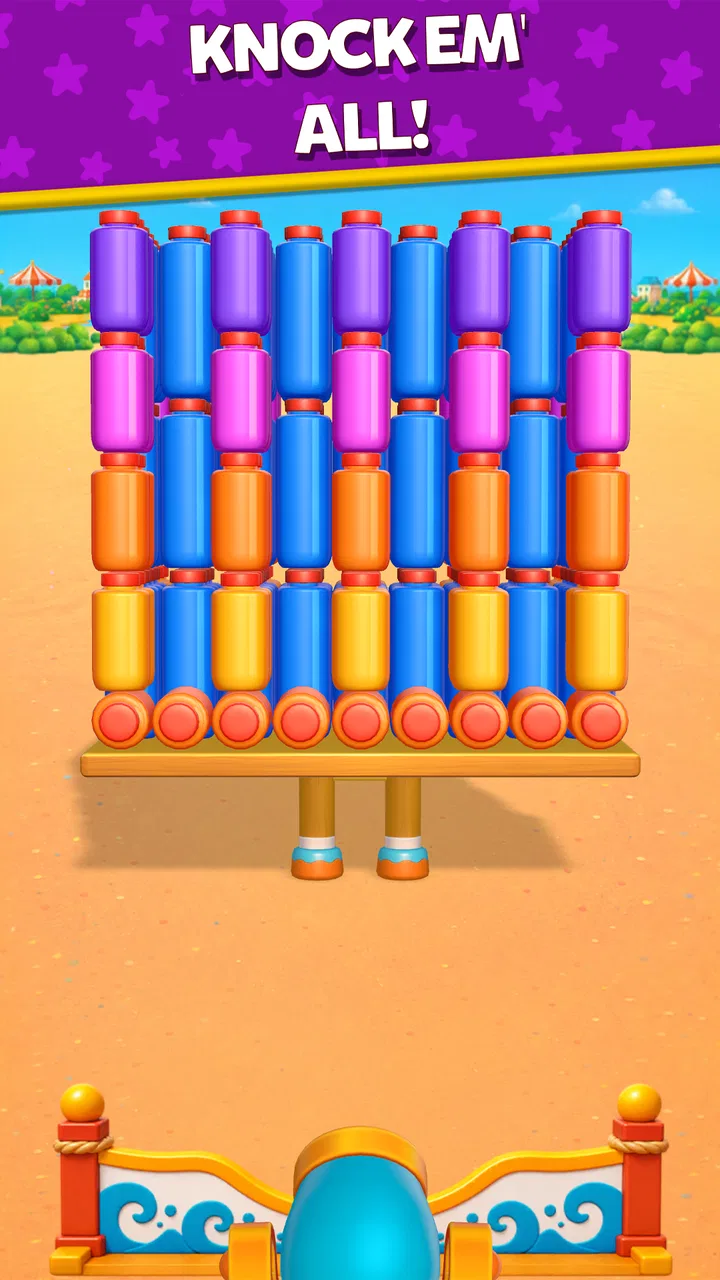
Smash Land!
- 4.6
- Rating
- 100.00K
- Installs
- Free
- Price

 Analysis by App-foxy
I went into Smash Land! expecting a quick puzzle game built around simple aiming, and that is exactly where it makes the best first impression. The basic appeal is immediate: line up a shot, fire, and try to cause as much satisfying destruction as the level allows. It is easy to understand without a tutorial-heavy introduction, which makes it a natural choice when I want something I can start playing in a spare minute.
That simplicity is also the reason I would not describe it as a deep strategy game. Its pleasure comes from judging angles, choosing a useful target, and improving a shot that almost worked. I found the experience most enjoyable when I treated each attempt as a small puzzle rather than rushing to launch anything that looked possible. The store summary, “Aim, fire, and smash your way!”, captures the action, but the more useful description is this: it is a light, destruction-focused puzzle game that rewards patience more than frantic tapping.
Getting started without turning a quick game into a chore
Smash Land! is free to download and is rated for Everyone, so it is approachable for families and casual players. Flow Games A.S. is the developer, and the game currently shows version 660. I would still begin with a few sensible checks before blaming the game if the first launch feels awkward: make sure the installation has finished, close other demanding apps, and restart the game if a screen appears to hang. These are ordinary steps, but they matter more in a short-session game because even a small delay can make the whole experience feel unreliable.
You May Also Like

 Blood Strike: 2.5 Anniversary
Blood Strike’s Loadouts Turn Every Drop Into a Tactical Gamble
A close look at Blood Strike’s custom loadouts: how fast access to signature weapons reshapes its battle royale rhythm, rewards preparation, and narrows the gap between fights.

 Pandora - Music & Podcasts
Pandora’s Music Is Easy to Start, but Harder to Recover
Pandora’s strength is its low-effort path from a seed to a station. Its weak spot is how much confidence it asks you to place in connection, setup, and quiet recovery.

 8 Ball Pool
 Is Built on Rivalries, Rematches, and Routine
A close look at the rivalries, rematches, shared routines, and unanswered safety questions that turn a quick pool match into a persistent mobile community.

 Samsung Music
’s Quiet Strength Is Playing What You Already Own
Its reach comes less from spectacle than from dependable access to a personal library. That simplicity is both the app’s strongest retention engine and its ceiling.

 AccuWeather: Weather Radar
AccuWeather Review: A Quick, Clear Forecast for Everyday Decisions
For everyday plans, the best forecast is the one you can understand quickly. AccuWeather makes rain timing, radar, and local conditions easy to act on, with a few trade-offs.

 Hill Climb Racing
Why Hill Climb Racing Still Turns Crashes Into One More Run
A tiny car, a bumpy hill and one more upgrade: Hill Climb Racing keeps resurfacing because its simple chaos makes every near-miss feel personal.
More From Our News Desk
View All News


One practical point is that “free” does not mean the entire experience is necessarily free of spending prompts. The game includes in-app purchases ranging from $1.99 to $99.99 per item. I recommend deciding in advance whether you are going to play without buying anything, especially if a child will use the device. The age rating makes the game broadly accessible, but a device owner should still review purchase controls before handing it over.
If the game does not appear after installation, I would first check the device’s app screen rather than repeatedly tapping the install command. If it opens and then closes, a full device restart is a better first move than repeatedly launching it. I would also avoid clearing app storage casually, because that can remove local progress in games that keep progress on the device. A safer order is restart, check available storage, update the operating system if it is overdue, and reinstall only when those simpler steps fail.
The first few rounds: aim before you fire
The central skill is reading the scene before touching the launch control. I found that the strongest shots were rarely the most obvious ones. A direct hit may break one target, while a slightly adjusted angle can send the impact into several objects or open a more useful route. That makes the game feel closer to a compact physics puzzle than a reflex test.
My advice is to pause for a moment and identify what the first impact is supposed to accomplish. Are you trying to remove a blocker, trigger a chain of destruction, or reach a target that is protected by surrounding pieces? Even when the levels are designed for quick play, this small planning habit reduces wasted attempts. It also makes failure informative: instead of thinking that a shot simply missed, you can tell whether the angle, timing, or target choice was the real problem.
Touch controls can create their own friction. If your finger covers the aiming area, use a slower, shorter drag and release only after the path looks intentional. Keep the screen clean and hold the device in a stable position. A loose grip can make a carefully planned angle feel inconsistent, particularly when playing one-handed on a crowded train or while standing in a queue.
Recovering when a level goes wrong
When a shot fails, I would not immediately repeat the same motion. First, decide what changed. If the projectile reached the intended object but the result was weak, aim for a different contact point. If it missed entirely, adjust the angle in a small amount rather than swinging to the opposite extreme. Small corrections are easier to evaluate and help you learn the level’s geometry.
A useful routine is to remember the first successful part of a failed attempt. If the opening impact worked, reproduce that section and modify only the next decision. This turns a frustrating restart into a controlled experiment. It is especially helpful for players who tend to overcorrect after one mistake, because dramatic changes often lose the information gained from the previous attempt.
If the game becomes unresponsive during play, I would wait briefly before tapping repeatedly. Multiple touches can make it harder to tell whether the game is processing an input or has genuinely stopped. If it remains stuck, exit normally and reopen it. Repeated force-closing, reinstalling, or deleting storage should be later options, not the first response. The goal is to recover the session while protecting whatever progress the game has retained.
There is also a difference between a difficult level and a broken level. A difficult level responds consistently even when the result is not what you wanted. A technical problem tends to show up as missing input, a frozen screen, or behavior that changes without a corresponding change in your aim. Separating those cases prevents you from treating a solvable puzzle as a software fault.
When the problem is the device, connection, or expectation
Not every rough moment originates in Smash Land!. A device with very little free storage may struggle to install or update games, while an overloaded background workload can make touch response feel delayed. If other apps are also slow, crashing, or failing to open, the game is probably only one symptom. Restarting the device and freeing a modest amount of space are sensible general remedies.
Network conditions can also confuse the diagnosis. If an installation, update, or purchase screen does not complete, check whether other online services are behaving normally before repeatedly trying the same action. I would avoid making a purchase while a connection is unstable, since a delayed confirmation can create unnecessary uncertainty. If the issue affects only the payment process, use the device’s normal store support route rather than treating it as a level or control problem.
Display settings can influence how comfortable aiming feels. Very small interface elements, heavy screen brightness, or a protective film that reduces touch sensitivity may make precision harder. Switching to a comfortable brightness, cleaning the screen, and trying two-handed play can reveal whether the difficulty is actually physical rather than part of the puzzle design.
Expectations matter too. Players coming from a large physics sandbox may find the game too compact, while people looking for a calm matching game may find the destruction-focused play more active than expected. Compared with traditional match-three puzzles, Smash Land! asks for spatial judgement and shot planning instead of color combinations. Compared with competitive action games, it is less about speed and more about finding an efficient solution. The better alternative depends on what kind of concentration you want.
Who will get the most from it?
I think the best audience is someone who enjoys short puzzle sessions and likes seeing a plan turn into a chain of impacts. It works particularly well for a person who wants a game that can be understood quickly but still offers room to improve individual attempts. The Everyone rating also makes it easier to recommend as a shared casual game, although adults should remember to manage the purchase settings on a shared device.
A realistic everyday use case would be a five-minute wait before an appointment. I would open the game, study one layout, make a careful attempt, and stop after a few rounds without needing to remember a complicated control scheme. That same structure suits a short break at home. The game is less suitable for a long uninterrupted session if you need a strong story, character progression, or a large world to explore.
The game’s visible audience is encouraging: it has an average rating of 4.6 from around 11K ratings, with over 200 written reviews and over 10K installs. Those figures suggest that the quick, accessible format has found a receptive audience, but they should not be read as proof that every player will enjoy the same pace. Ratings often favor games that deliver an immediate idea well; they do not remove the need to consider whether aiming puzzles are your preferred style.
I would also skip it if you dislike trial and error. Even a satisfying puzzle can require several attempts, and the appeal depends on being willing to adjust rather than expecting every shot to succeed immediately. Players who want completely predictable logic puzzles may prefer a traditional grid-based game. Players who want constant action may be happier with an arcade title built around rapid reactions.
Spending, patience, and a sensible play style
Because the game is free with optional purchases, I would begin with a no-spend test. Play enough to decide whether the aiming and destruction loop itself is enjoyable before considering any item. The listed purchase range is wide, from $1.99 to $99.99 per item, so there is a meaningful difference between a small convenience purchase and a much larger commitment. I would not buy simply because a difficult level creates pressure; if the core loop is not enjoyable without spending, a purchase is unlikely to fix that.
For younger players, the practical question is not only whether the content is suitable. It is also whether the device is configured to prevent accidental purchases. That is a household setting worth checking before play begins. For adults, the same advice protects against impulse spending during a frustrating run.
My strongest gameplay tip is to value information over speed. Use an early attempt to learn how the layout reacts, then make the next shot more deliberate. If a particular impact produces a useful chain, remember the contact point rather than only the general direction. This is a small but important distinction: repeating a direction is vague, while repeating a contact point gives you a workable method.
How it compares with familiar puzzle choices
Against match-three games, Smash Land! feels more physical and immediate. You are not scanning a grid for a color pattern; you are predicting how an impact will travel through a scene. That makes it a better choice for players who enjoy angles and cause-and-effect. Match-three games are usually easier to play while distracted, whereas this one benefits from giving the layout a brief look before acting.
Against classic brick-breakers, it shares the pleasure of clearing objects but places more emphasis on deliberate aiming. A brick-breaker can become a test of keeping a moving object alive, while Smash Land! is more about choosing the first action. If you prefer continuous motion and reflexes, the traditional alternative may hold your attention longer. If you prefer planning one shot at a time, this game has the stronger fit.
Against large puzzle adventures, it is much easier to pick up but offers less of the surrounding context that makes those games memorable. There is no reason to choose it for exploration or narrative. Choose it for a compact loop that can deliver a small mental challenge without demanding a long commitment. That narrow purpose is a strength when it matches your routine and a limitation when it does not.
My practical verdict after testing the routine
Smash Land! succeeds because its main idea is readable in seconds and its best moments come from a well-judged shot. I like that the game encourages me to inspect a layout, predict a result, and learn from a near miss. It is a good fit for casual puzzle players, families looking for an approachable game, and anyone who enjoys short sessions built around spatial decisions.
The friction is equally clear. Touch aiming can feel less comfortable on a small or dirty screen, technical problems may be confused with difficult levels, and the optional purchase range means shared devices deserve sensible controls. The game also has a focused identity: it is not a replacement for a story-driven adventure, a deep strategy title, or a rapid competitive game.
My recommendation is to install it if you want a free, accessible puzzle game centered on aiming and destruction, then judge it by the quality of the basic loop before spending anything. Start with careful shots, change one variable at a time when recovering from failure, and troubleshoot the device before assuming a level is broken. If you enjoy turning a simple launch into a carefully planned chain reaction, Smash Land! is easy to recommend; if you need depth, narrative, or nonstop action, choose a different puzzle style instead.
FAQs for Smash Land!
01What is Smash Land!?
Smash Land! is a casual arcade-style game focused on fast, satisfying destruction. Players typically interact with colorful environments, smash objects, complete short challenges, and aim for higher scores or better rewards. Its simple controls make it easy to start playing, while the increasing difficulty and collectible or upgrade elements provide additional goals for users who want more than a quick, occasional game.
02Is Smash Land! free to download and play?
Smash Land! can generally be downloaded and played without an initial purchase, making it accessible to most Android and iOS users. However, free games may include optional in-app purchases, advertisements, or paid items that improve progression or remove interruptions. Before downloading, check the store listing for the current pricing model, supported devices, and any purchase-related information available in your region.
03Does Smash Land! require an internet connection?
The basic gameplay in Smash Land! may work without a constant internet connection, which is useful when traveling or playing in areas with limited coverage. Nevertheless, certain features can depend on online access, including advertisements, cloud saves, leaderboards, events, updates, or in-app purchases. For the most reliable experience, launch the game online at least once and review its permissions and store description.
04Is Smash Land! suitable for children?
Smash Land! uses accessible gameplay and is likely easy for younger players to understand, but parents should still review its age rating and content details before installation. The main concerns are usually advertisements, optional purchases, data collection, and the possibility of repeated gameplay. If children will use the app, parental controls and purchase restrictions are recommended to prevent accidental spending.
05What devices are compatible with Smash Land!?
Compatibility depends on the version of Smash Land! available in your country and the requirements set by its developer. Before downloading, check the official Google Play or App Store page for the minimum Android or iOS version, required storage, and supported device information. Keeping your operating system updated can help, although older phones may experience slower performance, crashes, or longer loading times.
Pros
- Simple controls make it easy to start playing immediately.
- Short matches fit well into quick gaming sessions.
- Bright visuals give the game a cheerful
- accessible style.
- Physics-based attacks add satisfying impact to each move.
- Progression encourages repeated play and experimentation.
Cons
- Some levels can feel repetitive after extended play.
- Difficulty may become uneven as later challenges are introduced.
- Limited variety can reduce long-term appeal for dedicated players.
- Occasional physics behavior may feel unpredictable during battles.
- Progress may feel slow without investing significant play time.

Smash Land!
Gallery